Posts

Large Scale Irrigation: 'Help' from the Oppressor?

Image
Last week I focused on the traditional small-scale irrigation methods used by farmers. This week my blog will seek to explore how larger-scale methods have been adopted (perhaps not as successfully as first thought). Sub-Saharan Africa is heavily reliant on agriculture. It is an important employer, providing jobs to 60% of its residents and accounting for a total of 23% of the region's GDP.  Africa is unique in the sense that over 90% of its food production is dependent on rainfall.  This means that droughts here are likely to result in famines. As climate change becomes more extreme, the frequency and magnitude of such droughts in the tropics increases. Because of this, many NGOs and Western development agencies have pushed for the construction of large-scale irrigation techniques in a trend known as the 'New Green Revolution' The World Bank is one agency that has promoted this via neo-colonialist policies that tried to influence African development following independence...

Renewable Groundwater systems: Small-Scale Irrigation

Image
Last week we examined Africa's groundwater potential and how this could ensure water and food security via non-renewable systems. This week the focus will be on smaller-scale renewable extraction methods. Farmer-led irrigation has historically allowed for groundwater usage to occur without depleting the source. This development can be defined as a way in which farmer's take on a more important role when improving their agricultural water usage. This is done via changes in technology use, investment patterns, governance of water and land, and knowledge production. These processes normally occur informally all-over sub-Saharan Africa. Due to the informality of these processes, most farmer-led irrigation is not included in the official figures stating how much of Africa's agriculture is irrigated. This figure is currently 6% , but if these methods were included, it would be significantly higher. I will discuss the different example of farmer-led irrigation below. Shallow Grou...

Is Groundwater the answer?

Image
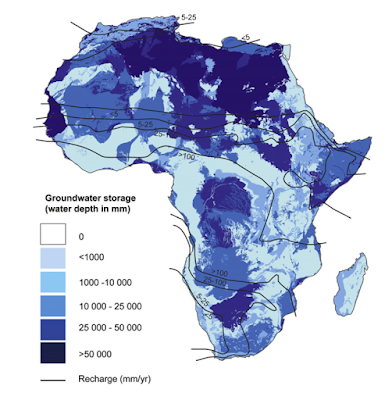
Groundwater development has proved integral in fuelling agricultural growth all over the Global South, most notably Asia.  As a result, groundwater in South Asia now supplies over half of the irrigation supplies. Unfortunately, Sub-Saharan Africa missed this Groundwater Revolution. However, recently there has been an increase in farmer-led irrigation methods utilising groundwater. This shows that perhaps the tide is turning. Thus, I will seek to show Africa's groundwater extraction potential and how this could help its agriculture. Figure 1: Map showing Africa's groundwater potential Africa sits upon a vast water reserve. Sub-Saharan Africa has such a large reserve that it is estimated it has over 3 times more groundwater availability per capita than China and almost 6 times more than India. This groundwater source is quantified as being roughly 0.66 million km ³.  To show the magnitude of this figure, lets compare it to these outputs below: - Average annual rainfall is estim...

Overcoming Colonisation

Image
  Before starting to look at any issues or solutions made by people in the African Water and Food discourse, I think it is imperative that we consider the dehumanisation that has systematically occurred to the citizens of this continent by the hand of the white oppressor .  Africa has perpetually suffered from the homogenisation of its unique cultures and traditions to a one-size-fits-all image that adheres to the western perception of what this continent should look like. Romanticised or demonised , the way in which it is presented aims to create an idea that it  is to be pitied and in dire need of aid. Of course, this aid will undoubtably come from the inevitable ‘heroic’ white saviour that is brave enough to venture into its ‘undeveloped savageness’ . My introductory blog aimed to discard these unsavoury images of Africa. It is therefore critical to understand that it is not a place to be pitied, but instead treated as any other continent. There is no desire from its c...

Water and Food in Africa - A brief introduction

Image
  Welcome to my blog on Water and Food in Africa! This is my first, introductory post where I hope to explain how these three key ideas are linked. Water and food are fundamental to life, which is why they make up two of the key Sustainable development Goals. My posts will aim to discuss certain issues pertaining to the interconnected nature of water and food security in African discourse.                          Water   Water can be considered the most important element for all ecosystems. It is fundamental for the survival and wellbeing of all living organisms. Despite being a renewable resource, its constant exploitation has meant that its resources are not being replenished fast enough to replace usage levels. This is particularly true when you consider the gaping imbalance between freshwater availability and the growing requirement’s of a developing worldwide population , thereby increasing per capita water...